
Surface Prep That Determines Whether Coatings Last
Concrete grinding and preparation in Jacksonville for floors with existing coatings, sealers, or contamination that prevent proper epoxy adhesion
Old coatings, paint layers, sealers, and embedded contaminants sitting on a concrete slab are not cosmetic problems—they are bonding failures waiting to happen. Any epoxy or polyaspartic coating applied over an unprepared surface adheres to whatever is on top of the concrete rather than to the concrete itself, and that layer eventually separates under load or thermal movement. Performance Epoxy in Jacksonville grinds and preps concrete floors as the foundational step of every coating project, and the 15-year delamination warranty the company backs its installed floors with depends entirely on prep work being done to specification before a single coat is applied.
The process begins with a moisture scan—concrete that is actively transmitting vapor through the slab requires a different primer and prep sequence than a dry slab. Existing coatings, paint, and sealers are removed by diamond grinding or shot blasting, which simultaneously opens the concrete's pore structure to the profile depth the coating requires for mechanical bonding. Older concrete in Jacksonville neighborhoods like Callahan and Yulee frequently carries decades of paint, sealer, and residue from prior uses that require more passes to fully clear than newer slabs. Once grinding is complete, the surface is cleaned, dried, and confirmed against the profile specification before any coating material is introduced. Skipping or compressing this step is the leading documented cause of epoxy delamination, and Performance Epoxy treats it as the most critical phase of any coating project.
To confirm your floor's prep requirements before scheduling a coating installation, arrange a surface assessment with Performance Epoxy.
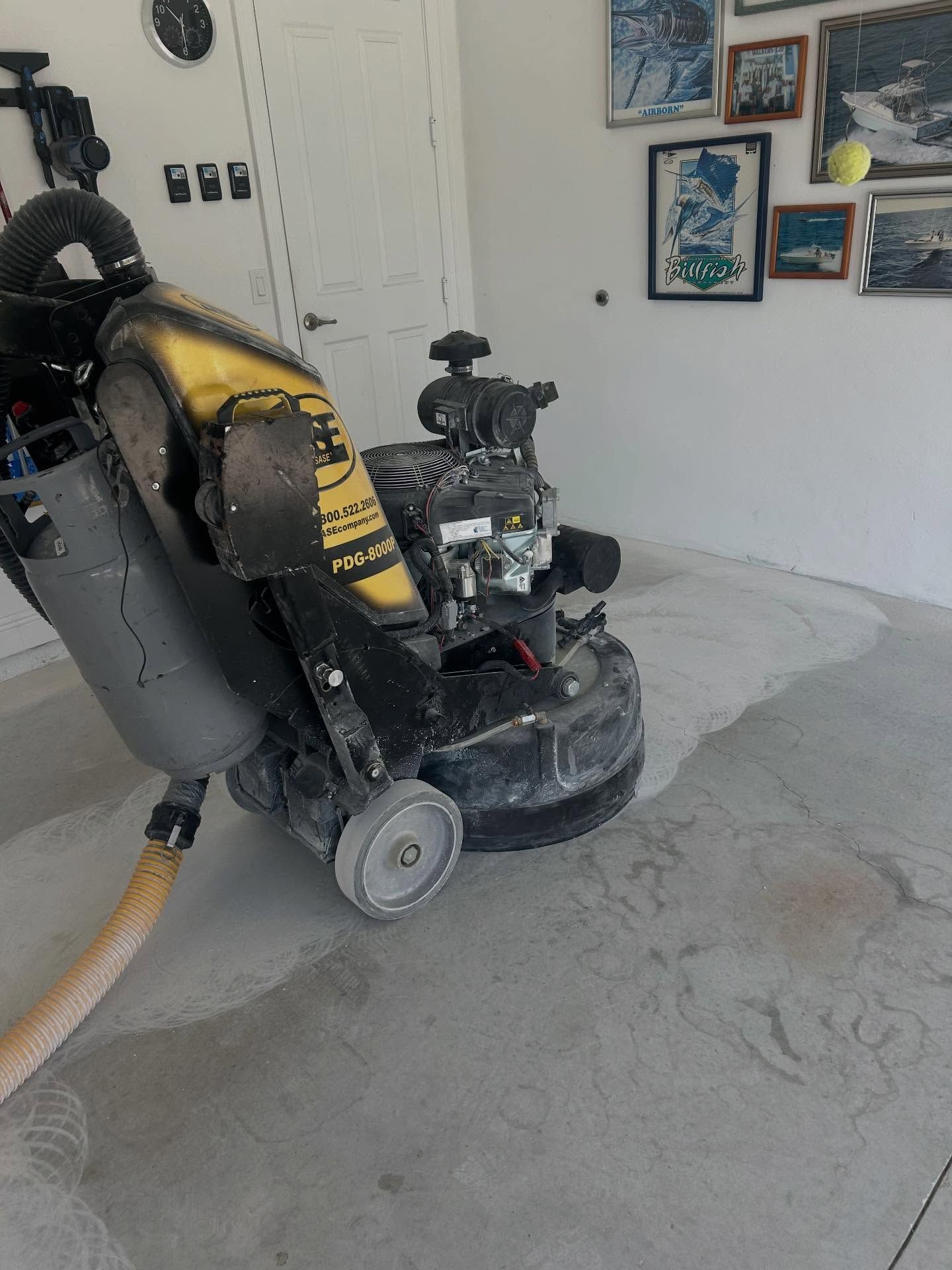
Why Grinding Is a Structural Step, Not a Surface One
Diamond grinding works by mechanically abrading the top layer of concrete to a controlled depth, removing surface contamination and creating a textured profile measured in a standardized range called Concrete Surface Profile, or CSP. The CSP number specifies how rough the surface is—higher numbers mean more texture and greater surface area for the epoxy to grip. The coating manufacturer's specification for a given product defines the CSP range required; applying that coating over a surface that is too smooth or too rough both result in reduced adhesion. Shot blasting achieves a similar result through impact rather than abrasion and is often used on larger floor areas where grinding coverage would take significantly longer.
After preparation is complete and confirmed, the floor is ready to accept the coating system at its specified adhesion strength. What the client will notice is that the finished coating does not show the edge-lifting, bubbling, or seam separation that appears when prep was insufficient. Over the years that follow, the floor maintains its bond at high-traffic points rather than showing delamination radiating outward from a seam or a corner where the old coating was not fully removed.
Prep scope is not the same for every floor. A previously sealed residential garage slab requires different treatment than a commercial floor that held heavy equipment for twenty years. The crew assesses what is present on and in the concrete and adjusts the prep sequence accordingly—there is no single-pass approach that works across all conditions.
Common Questions About How the Prep Work Is Done
Concrete preparation decisions are driven by what is on the slab, what is in it, and what coating system will be applied on top. These questions address the specifics of how grinding and prep work is actually performed and what it produces.
What is diamond grinding and how does it differ from shot blasting?
Diamond grinding uses rotating abrasive discs to mechanically remove the top layer of concrete, producing a textured surface profile suitable for coating adhesion. Shot blasting propels steel shot at high velocity to achieve a similar profile through impact—it covers large floor areas faster but leaves a different texture pattern that may require grinding follow-up in specific zones.
How does the crew determine when the concrete surface is adequately prepared?
The surface profile is compared against the coating manufacturer's specified CSP range using a profile comparator, and the crew inspects for any remaining sealer, paint, or contamination that would prevent bonding. Preparation is not considered complete until the profile and cleanliness both meet the spec, regardless of how many passes the grinding requires.
Why does old Jacksonville concrete often require more aggressive preparation than newer slabs?
Concrete placed in the 1970s and 1980s across residential and light industrial properties in the Jacksonville area was frequently sealed or painted multiple times over subsequent decades, and embedded surface treatments accumulate in layers that must be fully removed. Newer concrete typically arrives at the project with a cleaner surface history and reaches spec profile in fewer grinding passes.
What happens during the moisture scan before grinding begins?
A moisture meter or calcium chloride test measures how much vapor the slab is transmitting. High moisture readings indicate that standard epoxy primers may not seal adequately, and the crew shifts to a moisture-tolerant primer system that can accept bonding in those conditions without trapping vapor beneath the coating.
How does surface preparation affect how long the finished floor lasts?
Mechanical bonding strength between the epoxy and concrete is determined at the prep stage—no amount of additional coating thickness compensates for a surface that was not properly profiled. Floors prepped to specification hold their bond at seams, joints, and high-load points for the full rated service life; floors over inadequately prepped concrete begin separating at those same locations within the first years of use.
Performance Epoxy also performs concrete grinding and preparation in Ponte Vedra Beach, Orange Park, St. Augustine, Fernandina Beach, and Palatka. If your floor has an existing coating, sealer, or contamination that needs to be addressed before new material can be applied, connect with Performance Epoxy to schedule a surface assessment and determine the prep scope before work begins.