
Even Coverage That Holds Up Under Daily Use
Flake epoxy flooring in Jacksonville for garage floors and commercial concrete that need slip resistance and consistent visual coverage
Achieving consistent flake distribution across a concrete floor is a placement problem, not just a material one. Broadcast flake applied without controlled technique tends to cluster near the installer, thin out across the field, and pile up at edges—producing a floor that looks uneven at best and wears inconsistently because the coating depth varies with the flake density. Performance Epoxy in Jacksonville controls flake placement by tossing the broadcast material into the air above the floor, letting it rain down across the surface to achieve the even, consistent density that a quality installation requires. That method is the difference between a uniform finished floor and one with obvious variation across its surface.
Concrete preparation is completed to full mechanical specification before any coating material is applied—this is what the 15-year delamination warranty is built on. The epoxy base is then applied at material depths exceeding standard specifications, and the flake is broadcast during the application window to embed evenly into the coating. Residential garages and commercial spaces in Jacksonville use flake epoxy specifically because the texture provides slip resistance that smooth coatings do not, while the flake pattern conceals minor surface variation in older concrete slabs.
Request a free estimate to review your concrete surface and determine the flake density and color combination that fits your space.
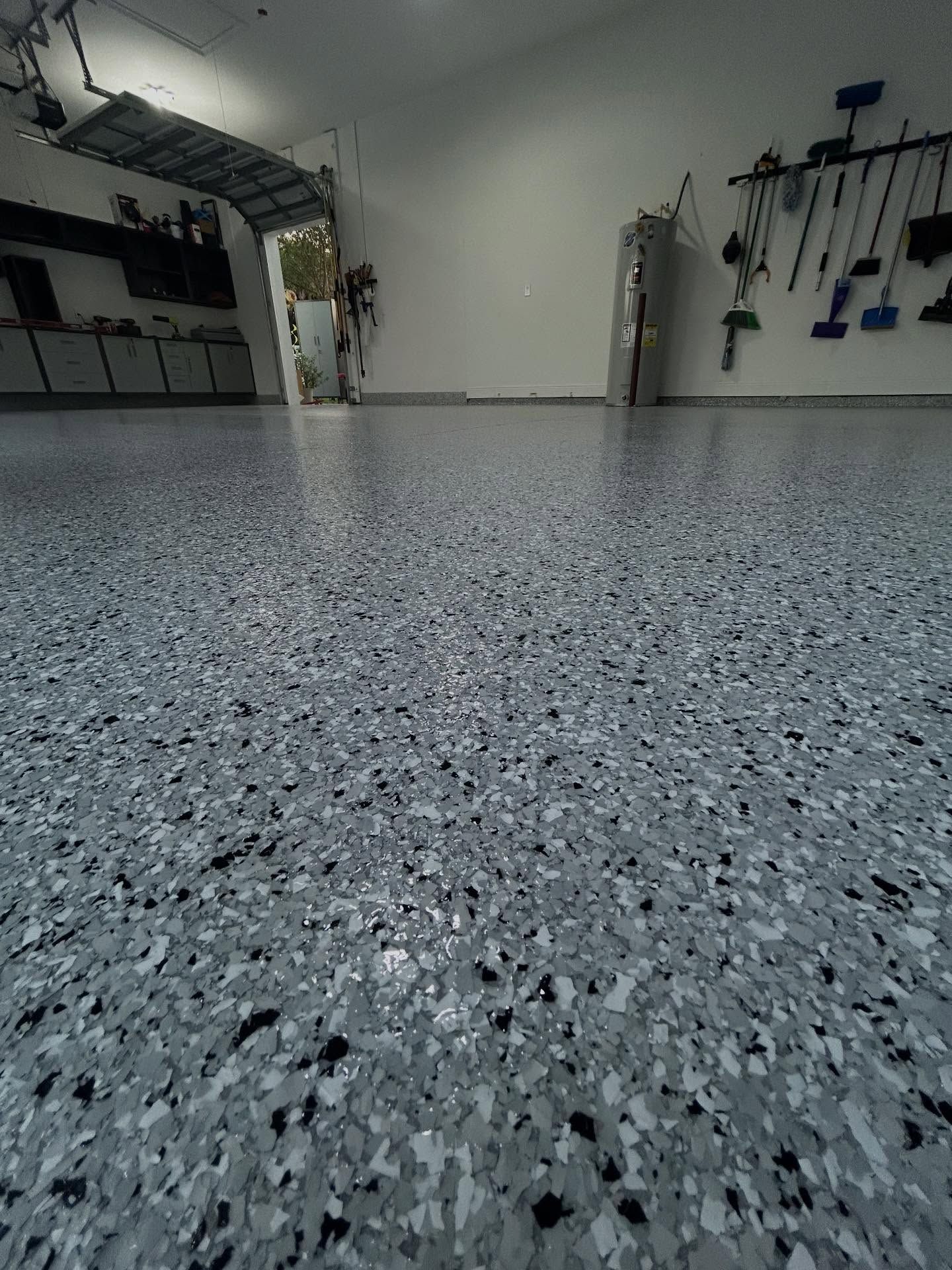
What Proper Flake Application Requires
Flake density is a choice that affects both the visual result and the surface texture of the finished floor. A full-flake broadcast—where the entire field is covered with overlapping flake—creates a uniform texture with minimal visible epoxy base color and maximum slip resistance. A partial broadcast leaves more of the base coat visible and produces a more open pattern. Performance Epoxy discusses these options before work begins so that the density and color combination chosen matches the intended use of the space and the look the client wants to achieve. Material is then applied at depth to ensure the flake layer is protected, not just sitting on the surface.
After installation, the floor's texture is immediately different from a smooth coating—the flake surface provides grip underfoot that is noticeable in a wet environment like a garage where oil or water from vehicles is a regular condition. Oil and moisture no longer penetrate the concrete because the sealed coating layer stops absorption at the surface, which means staining and surface degradation that uncoated slabs develop over time do not occur.
Flake systems can be applied over concrete in various conditions as long as preparation is completed correctly—surface contamination, previous sealers, and high-moisture slabs all require specific prep approaches before the epoxy will bond reliably. Performance Epoxy identifies those conditions during the estimate and addresses them as part of the installation rather than skipping steps that would compromise the warranty.
Common Questions About This Service
The questions below address how flake epoxy flooring is installed, what affects the finished result, and what to look for once the work is complete. Many of the concrete surfaces in Jacksonville's residential neighborhoods—particularly in areas like Yulee where slab construction on post-tension foundations is common—have specific prep requirements that affect how flake systems are applied.
How is flake broadcast to achieve even coverage across the entire floor?
Rather than scattering flake directly from waist height, which concentrates material near the installer's position, the crew tosses the flake upward so it separates in the air and descends across a wider area. This technique produces the consistent density across the full surface that a visual review of the finished floor will confirm.
What happens at the edges and perimeter of the floor where flake tends to thin out?
Perimeter areas require deliberate attention during broadcast because flake naturally travels less distance when tossed from the center of the slab. Proper installation accounts for this by adjusting the broadcast technique near walls and transitions so edge coverage matches the field density.
How does the condition of the concrete affect which prep method is used?
Slabs with existing sealers, oil contamination, or high moisture vapor transmission require different mechanical prep approaches—grinding depth, chemical treatment, or moisture mitigation steps—before epoxy will bond correctly. Skipping these steps produces early delamination regardless of the coating material quality.
What should you check in a finished flake floor to confirm even application?
Walk the entire floor and look for areas where the base coat color shows through more heavily than others, which indicates the flake density dropped in that zone. The texture should also feel consistent underfoot—areas with lower flake density will feel smoother than the rest of the surface.
Why does applying epoxy at greater-than-standard material depth improve the performance of a flake floor?
The flake is embedded in the coating layer, and the structural depth of that layer determines how long the surface holds up under abrasion. A thinner application means the flake is closer to the bottom of the coating, so surface wear reaches the bond line faster and the floor begins to show degradation earlier than a properly built system would.
Performance Epoxy completes flake epoxy installations throughout Jacksonville for residential garages, commercial spaces, and any concrete surface where a durable, slip-resistant finish is the goal. Performance Epoxy also installs flake
epoxy flooring in Ponte Vedra Beach, Orange Park, St. Augustine, Fernandina Beach, and Palatka. Call 904-316-6441 to set up a free on-site estimate and review the flake options available for your floor.