
Home Floors Built Past the First Few Years
Residential epoxy flooring in Jacksonville for homeowners with concrete in garages, patios, or living areas showing wear, staining, or surface failure
What changes after a properly installed residential epoxy floor is complete is specific and observable: the concrete no longer absorbs what contacts it, the surface cleans with a mop rather than a scrub brush, and the floor looks finished rather than utilitarian. Performance Epoxy produces that result in Jacksonville by applying epoxy systems at material depths that exceed what standard specifications call for and completing concrete preparation to the full standard that backs a 15-year delamination warranty. That combination—prep depth and material depth together—is what separates a floor that holds up over years from one that begins to peel at the edges inside eighteen months.
Every residential project begins with a conversation about color, finish type, and any decorative elements before prep work starts, so the installation is executed against an agreed design rather than adjusted on the fly. Concrete is then mechanically prepared to full specification—this is non-negotiable regardless of how new or clean the slab looks, because surface preparation is what allows the epoxy to bond structurally rather than adhesively. Material is applied at greater depth than competitors working at standard specifications, and a single crew gives the job focused attention through completion. Performance Epoxy completes approximately six residential installations per week across the Jacksonville area, which reflects the consistency of a business operating at full capacity rather than fitting residential work around commercial jobs.
Request a free estimate from Performance Epoxy to review your concrete surface and discuss the finish options available for your specific space.
What Residential Epoxy Flooring Actually Accomplishes
Residential concrete floors—whether in garages, patios, basements, or living spaces—share a characteristic: they were poured as structural slabs, not finished surfaces. The concrete mix and finishing technique used at construction were chosen for strength and cure, not appearance or long-term cleanability. An epoxy system applied correctly converts that structural slab into a finished surface by building a bonded coating layer above it that is hard, impermeable, and resistant to the chemical and mechanical loads residential use places on a floor. Homes in Palm Valley and World Golf Village—newer planned communities where large garages and enclosed patios are standard features—represent exactly the kind of residential property where concrete slabs exist in quantity but leave the surface condition unresolved after construction closes out.
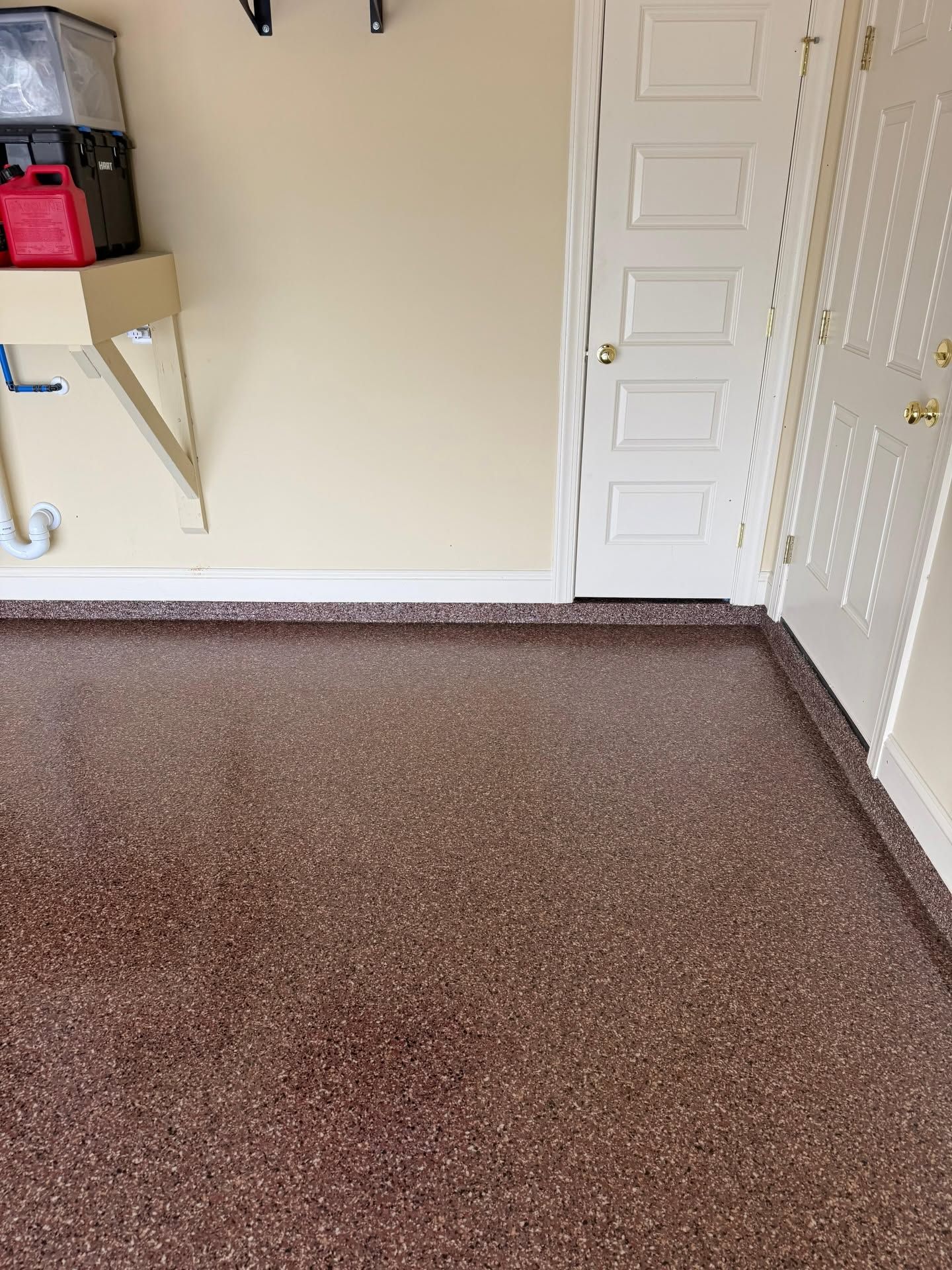
The visible difference after installation is unambiguous. A previously raw concrete floor that showed tire marks, efflorescence, or oil absorption will be sealed across its entire surface, with a consistent sheen that reflects light and makes the space appear larger and cleaner than it did before. Areas near transitions, walls, and drains—where poorly installed coatings fail first—should look identical to the center of the floor if the preparation and application were done correctly. That uniform result is the standard Performance Epoxy works to on every residential job.
The 15-year delamination warranty applies when prep and installation are completed to the full process standard, and the company is family-owned with the owner's brother working as a core crew member on installations. Performance Epoxy is licensed and insured, and free estimates are available for all residential projects.
Answers About How the Work Is Done
The questions below address what residential
epoxy flooring involves, how the installation process works, and what homeowners should look for in the finished result. Understanding the process helps evaluate both the quality of the work and the validity of the warranty that backs it.
How does the design consultation affect the installation process?
Agreeing on color, finish type, and any decorative elements before prep begins means the crew executes a defined result rather than making decisions during installation. Changes after prep has started can affect material sequencing, so the upfront discussion is an operational step, not just a sales one.
Why is mechanical concrete preparation required even on newer slabs?
Even recently poured concrete has a surface layer that is less porous than the material beneath it, and construction curing compounds or light contamination can close the surface further. Mechanical grinding opens the concrete at the cellular level so epoxy forms a structural bond rather than sitting on top of the slab where it can peel under lateral stress.
What makes a one-crew residential installation different from a larger commercial operation?
A single crew handling a residential job from prep through final coat maintains continuity in technique and material application—the same people who opened the slab are applying the finish, which reduces the variation that comes from handoffs between prep and coating teams. That continuity matters most for decorative finishes where consistency across the entire surface is the visual standard.
How does the finished floor behave differently from the bare concrete it replaced?
The coated surface will not absorb water, oil, or cleaning chemicals—liquids sit on top and can be removed without leaving residue in the slab. The surface also does not generate the fine concrete dust that bare slabs produce as they wear, which is a practical difference in garages and enclosed patios where air quality is a consideration.
What is the correct way to check that a residential epoxy floor was applied at proper thickness?
Visual consistency across the entire field—same sheen level at the center, perimeter, and near floor penetrations—is the primary indicator. Thin areas appear duller or show micro-texture from the underlying concrete grinding through the coating surface. An installer who applies at greater-than-standard material depth produces a floor where this variation is absent.
Performance Epoxy works with Jacksonville homeowners to install residential epoxy floors that are built to hold up under the daily demands of real use—not just look good on day one. Performance Epoxy also installs residential epoxy flooring in Ponte Vedra Beach, Orange Park, St. Augustine, Fernandina Beach, and Palatka. Call 904-316-6441 to schedule your free estimate and get started on your concrete surface.